
How to add a contact form to your Ghost site
Add a contact form to your Ghost site with no plugin using a custom HTML card. Copy-paste HTML plus an optional JavaScript submission with an inline thank-you message.
Ghost offers great tools to build websites. Let’s take a closer look at how you’d go about hooking your Ghost site up to FormBackend to receive form submissions. In this
tutorial we’re going to create a Contact form, with a name, email and message field. But you can create exactly what you want. Support form, lead intake form, subscriber form. With as many fields as you’d like.
Create a form for your contact form in FormBackend
Log in to your FormBackend account and visit the forms index page. Go ahead and create a new form and give it a name you can remember it by.
After your form has been created, you’ll see the “Submissions” page which is where new submissions will appear. If you navigate to the “Set up” page you can see the unique URL for your form. We’ll copy that!
Add a new Contact us page in Ghost
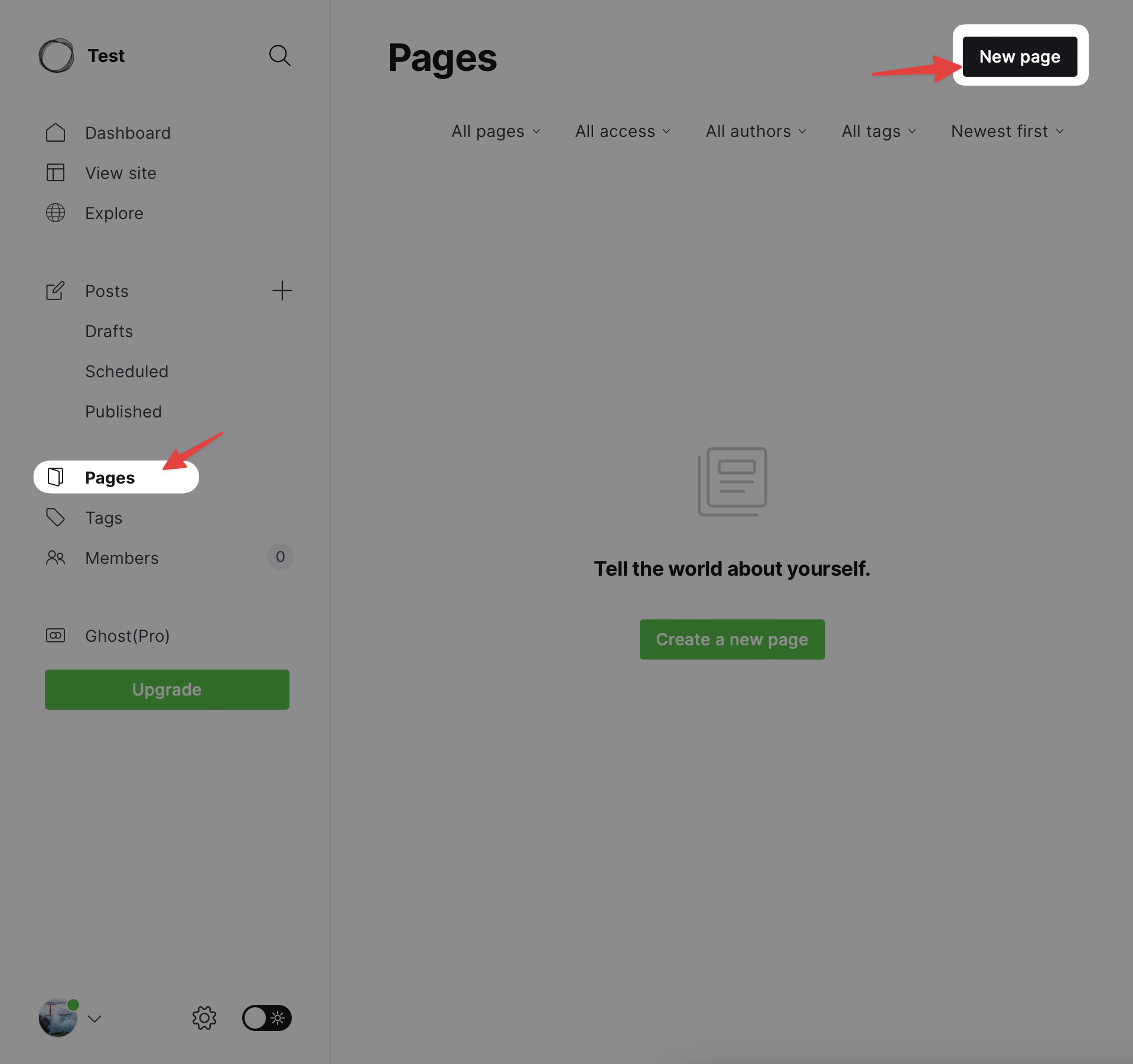
After you have logged in to Ghost, click on the Pages link in the sidebar and then click on New page
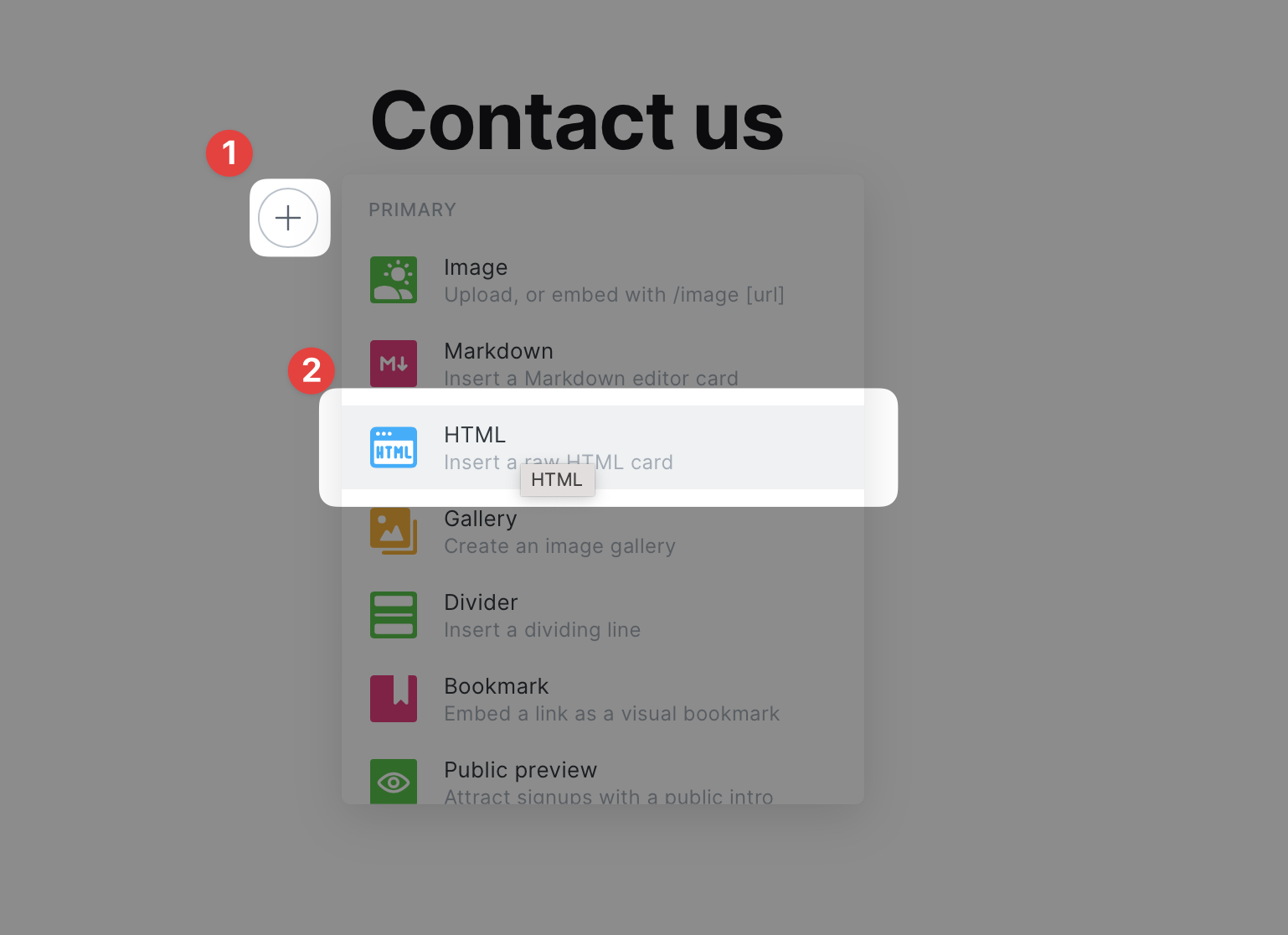
I’m going to give my new page a title of “Contact us” and insert a raw HTML card
We’re going to insert the following in to the custom HTML card
<form action="https://www.formbackend.com/f/{your-identifier}" method="POST">
  <div>
    <label for="name">Name</label>
    <input type="text" id="name" name="name" required>
  </div>

  <div>
    <label for="email">Email</label>
    <input type="email" id="email" name="email" required>
  </div>

  <div>
    <button type="submit">Submit</button>
  </div>
</form>
Which looks something like this in Ghost’s page editor
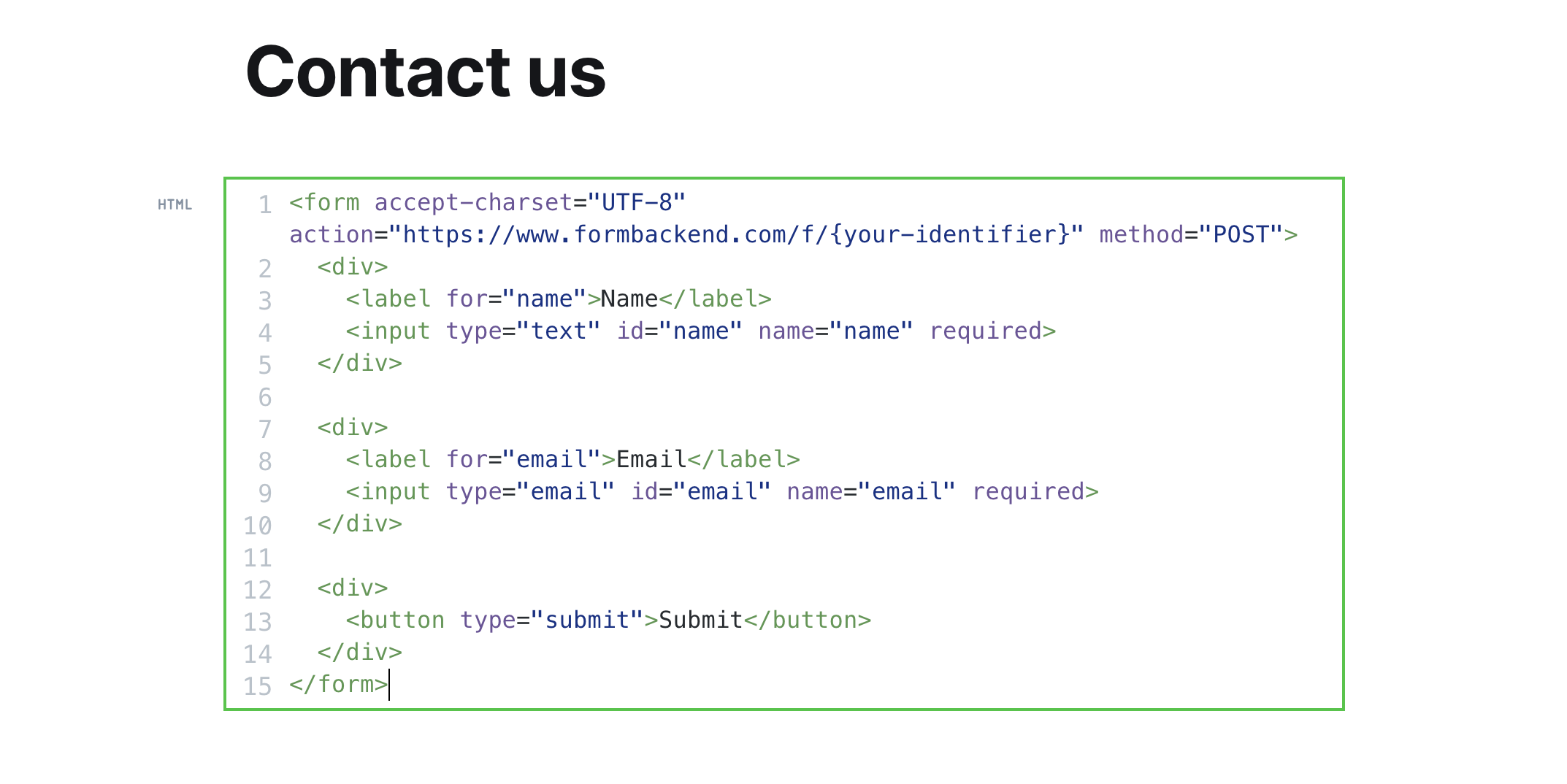
It’s now up to you to properly style it in Ghost to match your site.
After filling it out and hitting the submit button, you’ll be taken to FormBackend’s submission success page and if you navigate to the Submissions page for the form you created in FormBackend you should see the submission you just added.
Adding more fields
The example above only includes name and email, but you can add any fields you need. Just give each one a unique name attribute. For example, add a message textarea, a phone number field, or a dropdown. Ghost’s HTML card accepts any valid HTML, so you have full flexibility over your form structure.
If you need to accept file uploads, add enctype="multipart/form-data" to your form tag.
Submit without a page redirect
By default the form redirects to FormBackend’s thank-you page. To keep visitors on your Ghost site
and show a success message inline, add a <script> block inside the same HTML card, below your
form:
<script>
  const form = document.currentScript.parentNode.querySelector('form');

  form.addEventListener('submit', async (event) => {
    event.preventDefault();

    const response = await fetch(form.action, {
      method: 'POST',
      body: new FormData(form),
      headers: { accept: 'application/json' },
    });

    if (response.ok) {
      form.innerHTML = '<p>Thanks! Your message has been sent.</p>';
    } else {
      form.insertAdjacentHTML('beforeend', '<p>Something went wrong — please try again.</p>');
    }
  });
</script>
event.preventDefault() stops the full-page submission, the browser’s built-in
FormData collects every field, and the
accept: application/json header tells FormBackend to return JSON instead of an HTML page.
Notifications and integrations
With your Ghost form collecting submissions, configure these in FormBackend:
- Email notifications: Get an email with submission data every time someone submits, with optional file attachments
- Auto-reply emails: Send a confirmation to the person who filled out the form
- Spam protection: All submissions are checked for spam automatically. Add Cloudflare Turnstile for an extra layer of protection
- Integrations: Route submissions to Slack, Google Sheets, Notion, or any endpoint via webhooks
- Customize the thank-you page: Change the message users see after submitting, or redirect them to a page on your Ghost site
Looking for other platforms? See our guides for WordPress, Webflow, Hugo, and more.
Frequently asked questions
Do I need a plugin for a Ghost contact form?
No. Ghost has no built-in form handling, but you don't need a plugin. Paste a standard HTML form into a custom HTML card and point its action at a FormBackend endpoint — FormBackend stores submissions and emails you.
Does this work on Ghost(Pro) and self-hosted Ghost?
Yes. The form is just HTML in an HTML card, so it works the same on Ghost(Pro) and self-hosted Ghost, on any theme.
Where do I add the form in Ghost?
Create or edit a page (for example, "Contact us"), insert a custom HTML card, and paste the form HTML. You can do the same inside a post if you'd like a form within an article.
How do I submit a Ghost form without a page redirect?
Ghost HTML cards allow script tags, so you can add a small script that POSTs the form with fetch and shows an inline confirmation. A full example is shown above.
How do I add spam protection to a Ghost form?
FormBackend filters spam automatically. For more protection add Cloudflare Turnstile, hCaptcha, or reCAPTCHA, or include a hidden honeypot field. See the spam filtering guides.
Keep reading
How to add a form to your Gatsby site
Add a contact form to your Gatsby site with no backend. A complete React example that submits with fetch, shows an inline success message, and reports errors accessibly.
How to create a form in Astro (with Astro Actions)
Add a contact form to your Astro site with no backend. Copy-paste examples for a plain HTML form, a JavaScript submission with an inline thank-you, and the modern Astro Actions approach with server-side Zod validation.
How to create a React form (with validation)
Build a React contact form with no backend. Copy-paste examples for a plain HTML form, a fetch submission with success and error states, validation with React Hook Form and Zod, and the React 19 form action with useActionState.
Add a form backend to your site in minutes
Connect any HTML form to FormBackend and start collecting submissions — no backend code required.
Start free